
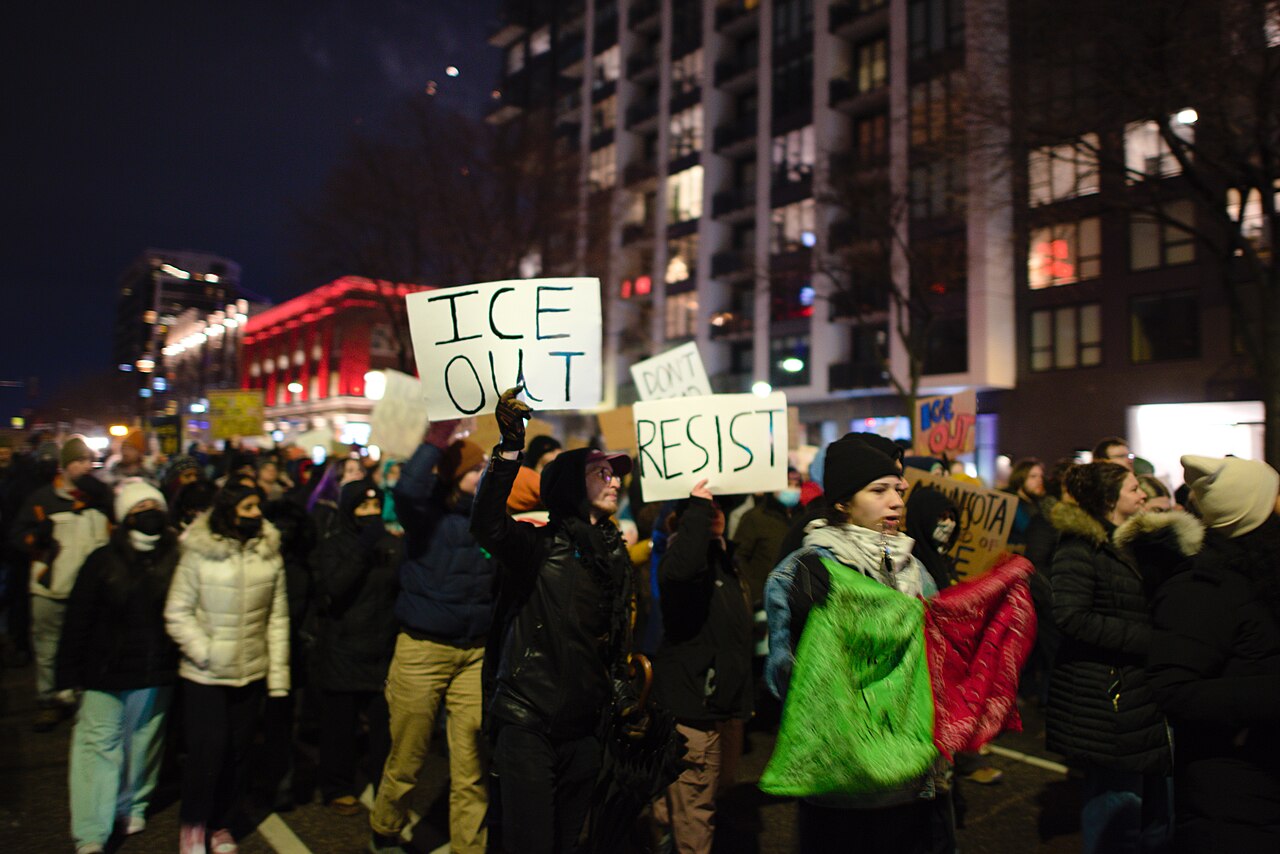


A surge of dark progressive money is powering Minnesota’s activist infrastructure, and several media sources indicate that the trail leads straight to the Hopewell Fund. As a central hub in the Arabella network — a for‑profit Washington, D.C. LLC consulting firm that manages and provides services to a network of large progressive nonprofits — Hopewell channels millions from major foundations into activist projects while keeping donor identities safely out of sight.
One of those projects — States at the Core (SATC) — has been using Hopewell funding to provide on-the-ground training in subversive mobilization tactics to Minnesota protestors under the anonymity afforded by fiscal sponsorship. According to Minnesota Public Radio:
Now, an organization in the Twin Cities is offering “ICE Watch training.” The training provided by States at the Core, or SATC, prepares neighbors to monitor, document, and fight against ICE activity. The organization says it has trained more than 1,000 Minnesotans so far.
The result is a funding system built for progressive influence while keeping the real decision‑makers anonymous and unaccountable. One of the participants in this pipeline was activist Renee Good, the young woman who was shot by an ICE agent after she drove her car into him. She and her partner, Rebecca, had spent the previous hours on the day she was killed attempting to prevent ICE officers from doing their job. At the time she was shot, she had been blocking traffic with her car in an effort to trap ICE agents’ vehicles and prevent them from leaving the area. Trained in these tactics, Renee Good was a participant in Minnesota’s ICE Watch community. According to news reports, Renee’s partner, Rebecca Good, was “part of the Powderhorn/Phillips ICE Watch neighborhood chat.” And, as Minnesota Public Radio points out, SATC is providing the ICE Watch training. (RELATED: The Media Are Agents of Propaganda)
Renee Good’s dangerous and unlawful behavior on the day she was shot illustrates how Hopewell-funded projects don’t just bankroll organizations — they cultivate individual organizers who then carry these sometimes deadly tactics into Minnesota’s political landscape. By the time Good emerged as an active participant in harassing federal agents and attempting to prevent their activities, the groundwork had already been laid by funded entities like SATC, further underscoring how deeply this hidden funding network is shaping on‑the‑ground activism in the state. (RELATED: The Death of Renee Nicole Good: Why the Democrats Will Fail Step Three in the George Floyd Script)
The result is a well‑financed activist pipeline whose true architects remain comfortably hidden.
SATC is not a standalone nonprofit at all, but a program housed inside the Hopewell Fund through its fiscal‑sponsorship structure. Operating as a Hopewell‑managed initiative, SATC has used that funding stream to provide the kind of on‑the‑ground training in subversive mobilization tactics that appears to have led directly to Renee Good’s death. The result is a well‑financed activist pipeline whose true architects remain comfortably hidden.
Still, since Hopewell is a 501(c)(3) organization, with IRS reporting requirements and guidelines, we can determine the funding sources of the Hopewell Fund. Recognized by the IRS on its 990 forms as a tax-exempt “public charity,” the Hopewell Fund functions as a fiscal sponsor that can receive tax-deductible donations from foundations, donor-advised funds, and individual donors. It houses projects like SATC inside its own legal and financial structure. That arrangement allows Hopewell to receive large, tax‑deductible donations from some of the country’s most influential progressive funders and corporate‑backed philanthropies, including the David and Lucile Packard Foundation, and Melinda Gates’s Pivotal Foundation, which donated $2.4 million to Hopewell, as well as $2 million from the Ford Foundation.
In addition to these major donors, the most recent Capital Research Center’s analysis of Arabella‑managed nonprofits identifies the following as donors providing more than $400,000 to Hopewell, including the Wyss Foundation, Omidyar Network, Heising‑Simons Foundation, Rockefeller‑affiliated philanthropies, Reid Hoffman (via donor‑advised funds), and the perennial progressive donor, George Soros (via Open Society network). Because SATC is not an independent nonprofit but a Hopewell‑run program, these same donors ultimately bankroll its operations — channeling national foundation wealth into Minnesota’s activist training. (RELATED: Arabella Advisors: the Dark Money Incubator for Leftist Billionaires)
While the donors who finance the Hopewell Fund are not legally responsible for the illicit actions taken by activists trained through its sponsored projects, their support does help sustain the organizational infrastructure that makes those activities possible. The combination of fiscal sponsorship, donor anonymity, and large‑scale philanthropic funding creates a system in which national foundations can underwrite programs that later intersect with contentious or disruptive protest activity, without being directly connected to the outcomes on the ground. This dynamic has prompted critics to raise broader questions about transparency and accountability in the philanthropic sector — particularly when tax‑exempt dollars flow into projects that operate in highly charged political environments. (RELATED: Minnesota and the New Nullification Crisis)
Many — including President Trump — have questioned whether the complex funding networks behind projects like SATC resemble the kind of coordinated systems that enable organized illegal acts. The questions emerge over whether the federal government would be able to apply federal RICO statutes against those like George Soros who have funded what they see as criminal enterprises. But most legal scholars have concluded that RICO cannot be applied to donors or nonprofits supporting protest‑related activity.
While progressive prosecutors have attempted to apply RICO statutes to pro-life networks, these attempts have been unsuccessful. The legal bar for applying the federal RICO statute is extraordinarily high, requiring proof of an organized criminal enterprise and a pattern of specific predicate offenses. Nothing publicly known about Hopewell or its donors meets that threshold, though the structure does raise broader questions about transparency and accountability in politically active nonprofits.
Even though the sheer volume of dark money behind violent protestors in Minneapolis and beyond can make resistance seem impossible, the most effective path forward is to begin to use existing institutions — including the IRS — to demand transparency and structural reform. That means tightening state disclosure rules for fiscal‑sponsorship arrangements, pressing Congress to modernize nonprofit reporting requirements, and urging state attorneys general to ensure that tax‑exempt entities are doing what they say they are doing in their grant applications for funding. Just like the fraudulent Somali-run daycare facilities and fake home health aide facilities throughout Minneapolis, charitable entities need to be forthcoming about their real activities.
The IRS guidelines do not allow the kinds of political activism that Hopewell is funding — they should be responding to this. A 501(c)(3) recipient is not allowed to participate in political advocacy. Teaching potential protestors to illegally block streets and block ICE officers from doing their job, and providing protestors with strategies that endanger the lives of federal agents and other citizens are already illegal and should be documented and prosecuted.
At the same time, building parallel research, legal‑advocacy, and community‑mobilization networks allows those who support the lawful work that federal agents are doing to compete with — rather than merely critique — the philanthropic networks shaping Minnesota’s activist landscape. The long‑term answer for those who support humane policies of law enforcement and deportation of criminal aliens is not retaliation but transparency, accountability, and the creation of durable civic institutions that cannot be quietly outspent and outmaneuvered.
READ MORE from Anne Hendershott:
A Feminized Police Culture Revealed by a Chief in Tears
From Solidarity to Statism: Mayor Mamdani’s Vision for New York City
Spite Repaid with Spite: The Metaphysical Roots of the Academic Massacre at Brown and MIT
Image licensed under Creative Commons Attribution 4.0 International.




















