
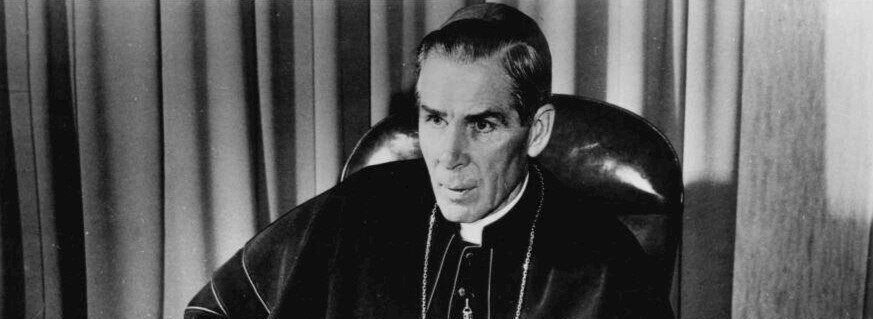


At the dawn of the 1950s, as atheistic communism was seeping into the West from the Soviet Union and as godless secularism and hedonism were on the rise in America, achieving the disastrous watershed known as the Sexual Revolution some years later, a Catholic bishop stood before a camera, a chalkboard over his shoulder, ready to preach to the largest congregation he had ever spoken to: the United States of America. Nearly 75 years later, that same Catholic bishop is on the verge of being beatified, an important step in reaching canonical sainthood.
“There are not one hundred people in the United States who hate The Catholic Church, but there are millions who hate what they wrongly perceive the Catholic Church to be,”
According to a report from The Pillar, the Vatican is preparing to announce a date for the beatification of Venerable Archbishop Fulton J. Sheen. Born in Illinois in May of 1895, the young Sheen served as an altar boy at his home parish before determining in early adulthood to become a Catholic priest. Even after having been ordained a priest and distinguishing himself as a theological scholar, Sheen’s youthful visage prompted a local priest to ask him to serve as an altar boy during Mass, unaware that the younger priest was, in fact, a priest.
In the 1920s, Sheen became the first American to win the Cardinal Mercier Prize for theological studies, thanks to his doctoral thesis, “The Spirit of Contemporary Philosophy and the Finite God.” Sheen studied at the Catholic University of America (CUA) in Washington, D.C. before going on to the Catholic University of Leuven in Belgium and the Pontificium Collegium Internationale Angelicum.
Both Columbia University in New York and Oxford University in England lobbied for Sheen to teach theology in their classrooms, but Bishop Edmund Dunne of the Diocese of Peoria in Illinois had promised Sheen to CUA. After a brief stint in priestly ministry in Illinois, where Dunne noted Sheen’s humility and obedience, the young priest was permitted to teach, but chose a post at St. Edmund’s College in England for about a year, before returning to teach at CUA, where he was a theology instructor for the next 22 years.
In 1930, Sheen began hosting a Sunday-night NBC radio program, The Catholic Hour, which he would host for another 20 years. The show became widely popular, reportedly receiving anywhere from 3,000 to 6,000 letters per week. Over the course of the program’s two-decade run, Sheen addressed everything from cultural issues to catechesis to explaining Catholic beliefs and practices for non-Catholic Americans.
Two years after The Catholic Hour concluded, shortly after having been named an auxiliary bishop in the Diocese of Rochester, Sheen began hosting a television show, Life Is Worth Living. The show featured Sheen speaking extemporaneously, often using a chalkboard, again addressing a wide range of subjects, from current events and culture to theology and evangelism to politics and the threat of communism. Life Is Worth Living was slated for primetime and competed against the Frank Sinatra Show and the Texaco Star Theater, starring Milton Berle. The Frank Sinatra Show was soon cancelled, while Sheen’s show only skyrocketed in popularity. The bishop won an Emmy Award during his first year on-air and the number of stations carrying Life Is Worth Living climbed.
Sheen forcefully denounced the Soviet Union and the threat of communism on his program, saying during a February 1953 show, “Stalin must one day meet his judgment.” Within days, Stalin suffered a stroke, dying just days later. Famously, Sheen was responsible for the conversion of Bella Dodd, who had once been a card-carrying member of the Communist Party USA (CPUSA) and a covert operative for the Soviet Union in the U.S. The bishop offered weekly catechism to a number of prominent individuals, mostly anti-communist intellectuals, like playwright Clare Boothe Luce, and ex-communists who later became staunch opponents of communism’s influence, such as Dodd and Louis F. Budenz.
Life Is Worth Living drew roughly 30 million viewers per week, predominantly non-Catholics, many of whom were introduced to Catholic principles aright for the first time in their lives. “There are not one hundred people in the United States who hate The Catholic Church, but there are millions who hate what they wrongly perceive the Catholic Church to be,” Sheen once declared. Life Is Worth Living ran until 1957, earning Sheen three Emmy nominations and one win. The Catholic apologist returned to television in 1961 with The Fulton Sheen Program, which followed essentially the same format as Life Is Worth Living and ran until 1968.
In addition to hosting his radio and television programs, Sheen also wrote extensively, authoring over 70 books, including Communism and the Conscience of the West, Three to Get Married, and The World’s First Love, a literary portrait of the Blessed Virgin Mary. In 1969, Sheen resigned as bishop of Rochester and was named the titular archbishop of Newport, Wales. When Pope St. John Paul II met Sheen in New York City in 1979, a mere two months before Sheen’s death, the pope warmly embraced the bishop and said, “You have written and spoken well of the Lord Jesus Christ. You are a loyal son of the Church.” Sheen died on December 9, 1979, kneeling in a chapel and praying before the Blessed Sacrament.
In 2019, Sheen was to be beatified, until Rochester Bishop Salvatore Matano alleged that Sheen may have mishandled a case of clerical sexual abuse. However, the abusive priest at issue, Gerard Guli, was never given an assignment by Sheen and had been removed from ministry before Sheen took over as bishop of Rochester. According to The Pillar, all concerns surrounding allegations of mishandling of abuse cases have been resolved to the Vatican’s satisfaction and the American Catholic televangelist is likely to be beatified in September.
READ MORE from S.A. McCarthy:
College of Cardinals To Meet Annually Under Pope Leo XIV




















