
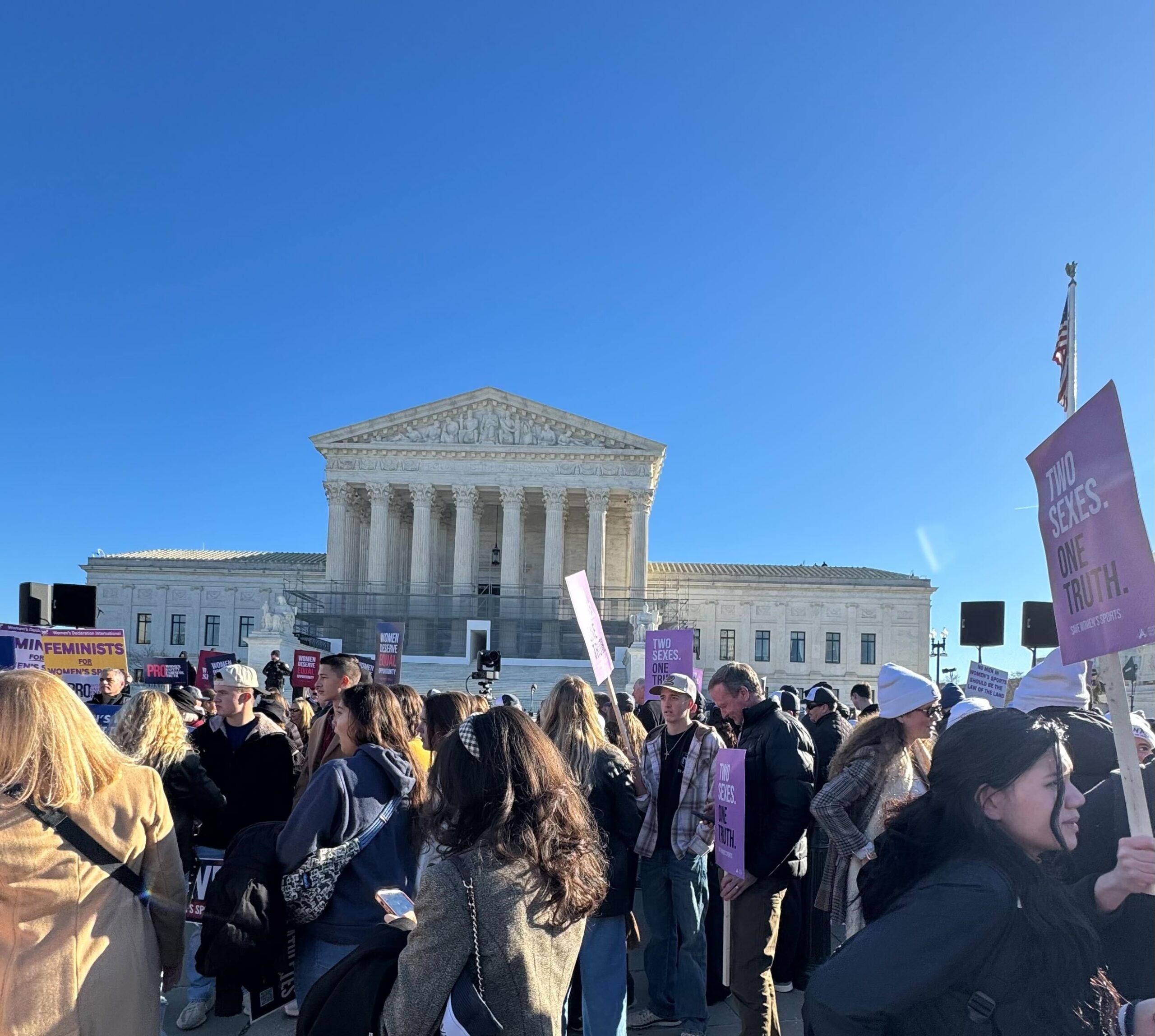


As the Supreme Court heard oral arguments Tuesday in two cases concerning state bans on men in women’s sports, supporters and opponents of the bans faced off outside the building in competing demonstrations.
The demonstrations came as the court considered two legal challenges to state laws governing male participation in women’s sports. This issue pushed many Americans to support Donald Trump and deliver him a landslide victory in last year’s presidential election, due to their shock at the blatant unfairness of allowing men to compete and dominate in women’s sports categories. While supporters of the legislation viewed the issue as one of protecting women’s rights, critics argue that the laws discriminate against male athletes identifying as transgender. (RELATED: Trump’s Ban on Males in Female Sports: What It Does, Why It’s Justified, and the Left’s Outrage.)
The cases before the court stem from state laws enacted over the past several years restricting biological boys and men from competing in girls’ and women’s sports. One of these cases challenges Idaho’s Fairness in Women’s Sports Act, passed in 2020, which bars boys and men who identify as transgender from competing in female athletic categories from elementary school through college. The law was challenged by 24-year-old Lindsay Hecox, a biological man who wanted to compete in women’s cross country and track at Boise State University. A second case involves a West Virginia law challenged by the mother of an 11-year-old biologically male middle school student, identified in court filings as B.P.J., after the child was barred from participating in girls’ sports. (RELATED: Religious Liberty Cases Return to Supreme Court)
Those rallying outside the Supreme Court to oppose men’s participation in women’s sports based their arguments on competitive fairness and safety for female athletes. Tammy Fitzgerald, executive director of North Carolina Values, brought three buses of people from North Carolina to support the state laws. Fitzgerald acknowledged the potential for nationwide changes as a result of the court’s decision, stating, “This is going to be applied in a lot of different places. Being able to decide that as a country, as a nation, as states, ‘we believe in only two sexes.’ That has ramifications that ripple across all the laws in every state.”
Other demonstrators come at the issue from broader perspectives. Margot Heffernan, an activist with the Women’s Liberation Front, said she attended as a “radical feminist” to “protect the rights of women and girls.” She argued that “women have had our own sports granted to us legally … for quite a few years now” and then explained “women need their spaces. We cannot compete against men. We are totally different.” Lauren Leggieri, co-executive director of LBG Courage Coalition, took aim at the activists on the other side of the aisle, saying, “LGBTQ is a myth! There is LGB, which is based on reality-based, sexual attraction, and the rest is a political agenda.”
“If you’re so sure of your beliefs, you should be able to articulate them clearly and defend them in a debate. Refusing to debate is not a winning strategy.”
Several rallygoers on the side of protecting women’s sports expressed frustration with the refusal of many dissenting protesters to engage in civil dialogue and debate their ideas. Teresa Pregnall, Concerned Women of America’s (CWA) Virginia state director, said, “We need to be able to talk to one another. That’s the mature way of dealing with things. I encourage those who oppose what we stand for, ‘Let’s talk about it.’” Faith Ozenbaugh, national student director for CWA, articulated concern for the counterprotesters. She said, “We know that a lot of their behavior, their vitriol, comes from abuse and brokenness in their own lives. Our desire for them is healing.” When asked what message she had for protesters on the other side, Leggieri echoed a similar sentiment: “If you’re so sure of your beliefs, you should be able to articulate them clearly and defend them in a debate. Refusing to debate is not a winning strategy.”
Former NCAA swimmer Riley Gaines was among the many athletes, activists, and lawmakers who addressed the crowd. Gaines stated, “[The other side] loves to hide behind words, like ‘compassion’ … It’s not compassionate to ask a young girl to strip down naked in front of a man, while he simultaneously undresses.” She continued, “They love to use the word ‘progressive’ … This is utterly regressive, it is taking us back at least half a century.”
Toward the end of her speech, Gaines said she hoped that this fight would make for her daughter’s world a better place. In attendance with her husband and daughter for the rally, she remarked, “It’s a pretty a wild thing when you have to dress your 3-month-old baby in a bulletproof vest.” Another speaker exclaimed, “Trans don’t exist. There are only men, women, and confused, abused children.… We’re done with that!” While she said this, she taunted the other side, who tried to drown her out with constant noise. One lawmaker, explaining the urgency of the issue, put it very bluntly: “If we don’t make a stand now, our country will go down so fast, our heads will swim.” (RELATED: Spat Between Gaines and AOC Shows What’s Wrong With the Democrat Party)
For some rally speakers, the issue was deeply personal. Macy Petty, a former collegiate athlete and legislative strategist with Concerned Women for America, told The American Spectator her involvement began during her high school volleyball recruiting season, when she competed against a male athlete in the women’s category while college scouts were present. “He got to bypass the rules and rob all of us [female athletes] of our opportunities to compete safely,” Petty recalled. She spent four years trying to change the NCAA from the inside, but “the NCAA would have nothing to do with me,” she explained. On Monday, Petty invited NCAA president Charlie Baker to join the stage with her at the Supreme Court. She explained, “If you really and truly want to empower female athletes, stand for female athletes, and I will see you on the steps of the Supreme Court.” Charlie Baker did not attend the rally.
Petty believes the cases before the Supreme Court reflect concerns female athletes have raised for years without being taken seriously by Congress or athletic institutions. “Back [in] 2018, this wasn’t really an issue anyone was talking about … I, at the time, was honestly confused. I didn’t understand how someone could so easily cheat and get away with it,” she explained. Petty explained that she supports allowing athletes who identify as transgender to compete in the male category. “I think that a man, even if he identifies as transgender, should still have the opportunity to compete and train. He just doesn’t get to be exempt from the rules,” she said. When asked about the changes she would like to see in America if the court rules in her favor, Petty replied, “I hope that it would embolden Congress … It would legitimize our concerns as female athletes … We are often dismissed … The highest Court in our nation is taking our concerns seriously. That is gonna be a huge shift.”
Another group of demonstrators argued that these state laws unfairly target transgender-identified males and frame their participation in sports as an attack on their “human rights.” Rushad Thomas, who said he attended in support of “transgender brothers and sisters who are being scapegoated by the Right in the United States,” explained “That’s all that transgender people want. They just want to be able to exist in society and live their life” and “We need to stop all these attacks on them because they are a tiny percentage of the population.” Rushad further stated that he has “friends who are transgender” and “I don’t think you need to have personal experience of people to commiserate with them and empathize with their plight.” A member of the Episcopal Church, Rushad said, “I believe that trans people are beloved by God.”
The National Council of Jewish Women (NCJW) also attended the rally. Along the sidewalk adjacent to the Court, an NCJW spokeswoman addressed a small crowd of supporters holding signs depicting Jewish symbols warped by pro-trans colors. The spokeswoman began, “Trans [sic] rights are under attack. It’s an attack on our trans siblings, our trans selves, all of us.” She then attempted to rebrand Donald Trump’s famous line, as she exclaimed, “We will fight, fight, fight to save lives.” She went on, “As a closeted trans kid, sports were life-saving for me. They let me be one of the boys.” When asked for his message to people on the other side of this issue, one NCJW supporter said, “It’s not that deep. Why are you so pressed? Why are you obsessed with this?”
The majority of activists opposed to the bans on men in women’s sports refused to be interviewed. Many of these individuals alleged that one must first visit the “press table,” who were “filtering out our requests” before interviewing any of them. Once a transgender activist media person was identified, the woman said, “We’ll circle back and see who’s available.” Upon returning to the table to find who was available, she was more standoffish, saying, “Yeah, we already spoke. We will definitely connect you,” before ending the conversation there.
As demonstrators dispersed from the court’s steps, the legal questions at the center of the rally remained unresolved. Based on the oral arguments presented, it appears that the court will uphold Idaho and West Virginia’s state bans on men in women’s sports. Justice Alito appeared to represent the sentiment of the majority of Americans in his response to a lawyer representing the biological male from Idaho, “How can a court determine whether there’s discrimination on the basis of sex without knowing what sex means for equal protection purposes?”
READ MORE:




















