
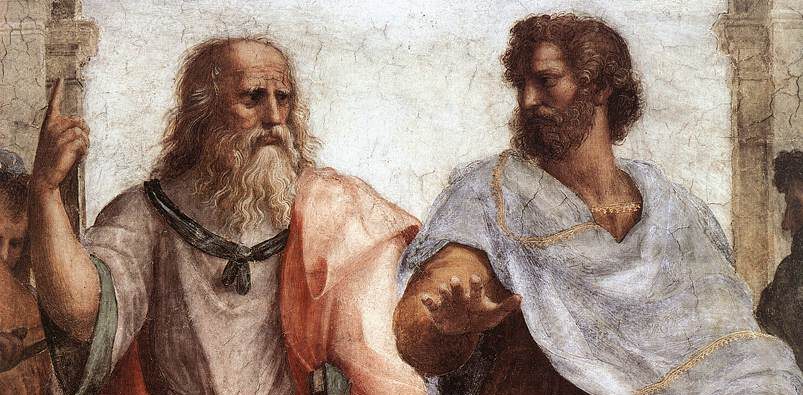


There’s a sense of triumphalism in the headlines.
“Texas A&M is banning Plato, citing his ‘gender ideology,’” one caption at Literary Hub read. “An ancient Greek philosopher falls victim to campus culture wars,” another headline at the Washington Post said. “This Is No Way to Run a University,” the New York Times assured its readers.
The Left, you see, has caught the Right in a bit of hypocrisy — or so it thinks.
It wasn’t so very long ago that the Right was loudly protesting teachers and schools that criticized (and sometimes banned) great authors like Shakespeare for challenging our modern progressive morality while traumatizing our students with accounts of extreme weather.
Now, suddenly, the Right is the one doing the canceling. To make it even better, they’re canceling one of the fathers of the very Western civilization they so often claim to defend. (READ MORE: A Nation That Can’t Explain 1776 Urgently Needs a Civic Education Revival)
So, how exactly did Plato get scrubbed from a philosophy course at Texas A&M? Well, its administration is (understandably) a bit nervous about the Trump administration’s determination to cut funding to institutions indoctrinating their students in the creed of gender ideology. So, a new policy requires school presidents to ensure all syllabi are free of gender and race ideology.
That policy was implemented days before the spring semester began and it affects some 200 courses (mostly those dedicated to philosophy, literature, film, sociology, communications, and ethics). Some of those problematic classes will no longer count toward core requirements, others will be revised.
Among the latter is an introductory philosophy course (PHIL 111, Contemporary Moral Issues) taught by Martin Peterson. According to the Texas Tribune, Peterson was informed that he had to either “remove the modules on race ideology and gender ideology, including readings from Plato, or be reassigned to teach a noncore philosophy course.”
The problem, the university told the Tribune, wasn’t Plato, per se, but the specific reading: a telling of the “Myth of the Androgyne” taken from Plato’s Symposium.
It’s a relatively short passage in which one of Plato’s characters, Aristophanes, waxes mythological on the nature of Love, positing that men and women were once joined in a single, four-legged, bug-like form until the gods determined that they were entirely too revolutionary and split them into two individuals. Love, he argues, is simply the desire to return to that original state of union with man’s other half.
As a sort of side note, Aristophanes remarks that “the sexes were three … because the sun, moon, and earth are three; and the man was originally the child of the sun, the woman of the earth, and the man-woman of the moon.” He then goes on to appear to justify lesbian attractions on the basis of humanity’s original construction. (READ MORE: ‘Experts’ Warn US Is on Brink of ‘Trans Genocide’)
It’s certainly possible that the leftist journalists and philosophers protesting Plato’s cancellation are correct in assuming that the university administration found the passage intrinsically problematic, and therefore determined to excise it. It’s also possible that the head of the department and the school’s president looked at the syllabus, noted that the passage was invoked in a module on gender ideology, and concluded, based on the context, that its inclusion was intended to aid a mission of indoctrination.
After all, there are two ways to interpret this passage in the context of gender:
You could, of course, interpret it as a kind of justification for homosexuality. The argument goes thus: the ancient founders of our Western civilization clearly didn’t have a problem with homosexuality, modern prejudices against it are just that, modern. Arguing that LGBTQ ideology is immoral actually breaks from our Western tradition. Gotcha.
Or, you could pair it with a reading of God’s creation of man in Genesis and His subsequent destruction of Sodom and Gomorrah for their deviant sexual practices. You could note that Aristophanes isn’t all wrong (Christ, after all, makes it clear in the New Testament that man and woman “become one flesh” in marriage), but that he, like most pagans both ancient and modern, had an understanding of sexuality that proved too broad. You could use this tidbit of philosophical history to suggest that Christianity didn’t just build on ancient greats like Socrates and Aristotle, it sanctified them.
Maybe I’m being unfair to Peterson, but I suspect he wasn’t planning to espouse the latter interpretation.
READ MORE by Aubrey Harris:




















