
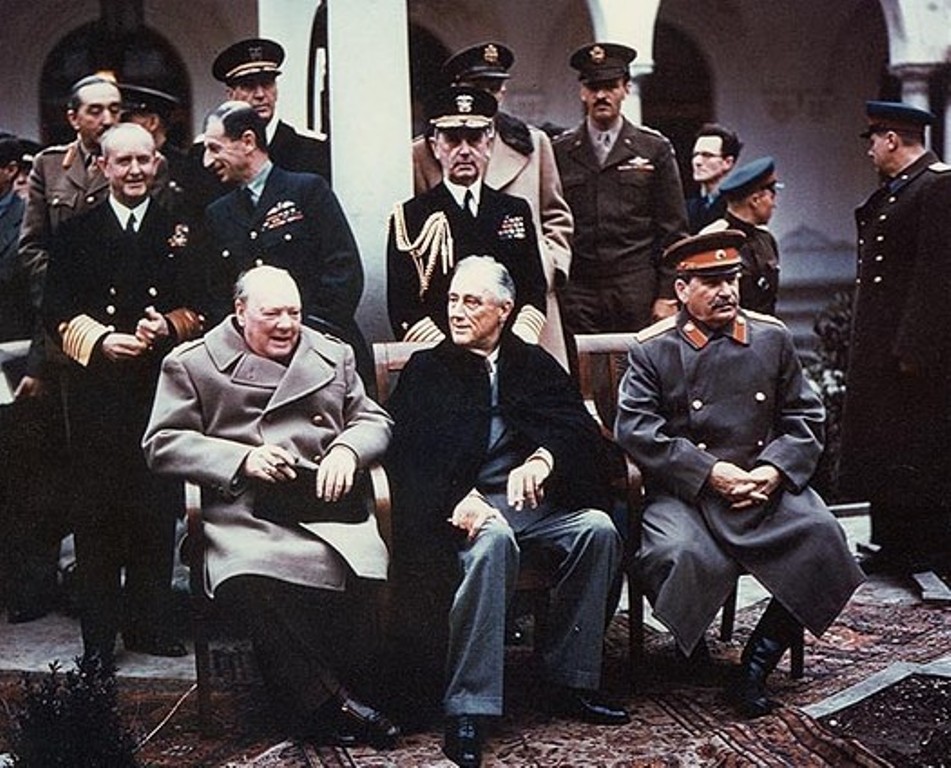


Eighty years ago this month, the United States and Great Britain effectively conceded Eastern Europe and parts of Central Europe to Soviet control at the infamous Yalta Conference held at the Livadia Palace in the Crimea. Forty years later, President Ronald Reagan in a statement on the 40th anniversary of the Yalta Conference pledged to undo the moral stain of Yalta. The “boundary which Yalta symbolizes,” Reagan said, “can never be made legitimate.” He described it as “the dividing line between freedom and repression.” More than four years after Reagan’s remarks, on Nov. 9, 1989, the Berlin Wall started to come down and the stain of Yalta began to fade away.
Reagan had set this in motion very early in his first term when he publicly called the Soviet Union an “evil empire” and prophesied that communism would end up on the ash heap of history. Reagan spoke about the economic crisis within the Soviet empire and pursued politically subversive policies that exploited Soviet vulnerabilities.
The conventional and nuclear weapons build-up was part of the strategy, but so too was aid to anti-communist resistance forces within the empire (the “Reagan Doctrine”), support for the Solidarity movement in Poland, agreements with the Saudis to reduce the price of oil, the stationing of cruise missiles and intermediate-range nuclear missiles in Central Europe, and public diplomacy that undermined the legitimacy of Soviet rulers.
The “victims” of Yalta were the peoples of Poland, Hungary, Czechoslovakia, Romania, East Germany, Yugoslavia, Albania, and Bulgaria who suffered 40 years of repression behind the communist “Iron Curtain.” President Franklin Roosevelt and Prime Minister Winston Churchill accepted (Churchill reluctantly so) Stalin’s false promise of free elections.
Stalin’s achievement and the West’s disgrace were brilliantly captured by Whittaker Chambers who after Yalta wrote a “fable” for Time magazine titled “The Ghosts on the Roof,” which imagined the Ghosts of the murdered Romanov family chatting with the Muse of History on the roof of the Livadia Palace. The Ghost of Czar Nicholas II praises Stalin for his statesmanship, vision, and power. “We have known nothing like it since my ancestor, Peter the Great, broke a window into Europe by overrunning the Baltic states in the 18th century,” Nicholas proclaims. “Stalin has made Russia great again.” (RELATED: Whittaker Chambers’ One-Man War Against Communism)
There were other victims of Yalta, too, who Nikolai Tolstoy immortalized in his book Victims of Yalta. These were Soviet POWs who at the end of World War II were forcibly repatriated to Stalin to face death or imprisonment in the Gulag. Tolstoy called this a “secret betrayal” as opposed to the public betrayal of the nations of Eastern and Central Europe.
The great analyst of communism and U.S. foreign policy, James Burnham, noted that until Reagan “Yalta” symbolized the foreign policy approach of the United States toward our Soviet adversary. Burnham wrote that the “Yalta strategy” was particularly pronounced during the Kennedy administration when the denizens of Camelot pursued a “Soviet-American condominium” manifested in U.S. acceptance of the Berlin Wall. It was part of Reagan’s public diplomacy to stand at the Brandenburg Gate and call upon Soviet leaders to “tear down this wall.” (RELATED: Remembering the Prophetic Power of James Burnham’s ‘Lenin’s Heir’)
Liberal historians have repeatedly given FDR a pass for his failure at Yalta. But FDR’s own diplomats knew better. Charles Bohlen, who accompanied FDR at Yalta, said that Roosevelt “felt that Stalin viewed the world somewhat in the same light as he did and that Stalin’s hostility and distrust … were due to the neglect that Soviet Russia had suffered at the hands of other countries for years after the Revolution.” FDR, Bohlen continued, failed to understand “that Stalin’s enmity was based on profound ideological convictions.”
Averell Harriman said that FDR had “no conception” of Soviet intentions and felt that he could “persuade Stalin to alter his point of view on many matters that … Stalin [would] never agree to.” George Kennan once remarked about Roosevelt’s “inexcusable ignorance about the nature of Russian communism [and] the history of its diplomacy.”
Yalta and its undoing are testaments to FDR’s failure and Ronald Reagan’s greatness.
READ MORE from Francis P. Sempa:
Wilsonian Foreign Policy Is Dead — For Now




















