

Until the other day, I was unfamiliar with the work of Rob Tregenza, a Kansas-born, UCLA-educated filmmaker who has written, directed, and photographed five pictures. Reviewing the first, Talking to Strangers (1988), which was shot in Baltimore, Jonathan Rosenbaum wrote that it “consists of only nine shots, each a ten-minute take. Each shot features the same character …whose identity appears to shift somewhat from one sequence to the next … in the first and last shots he is alone, and in the seven intervening sequences — the order of which was determined at random — he encounters one or more strangers,” including a Catholic priest and a “nihilistic thug.”
In short, not exactly your typical commercial Hollywood picture. Tregenza’s later films have been equally offbeat. In The Arc (1991),” an out-of-work welder goes on a cross-country road trip and meets odd people.” Inside/Out (1997), according to the New York Times, is about “a French artist who has been committed to a mental institution in the United States,” where “the patients … attempt to interact despite the emotional distance between them.” And in Gavagai (2016), “a grieving husband whose wife had been translating [Norwegian writer Tarjei] Vesaas’ poems into Chinese before her death … travels to Telemark, Vesaas’ home turf, partly in the hopes of finding a fitting resting place, and partly in an attempt to come to terms with his grief.”
Emotional distance; clergy; snow; minimal plot and dialogue; long takes: these are some of the recurring elements in Tregenza’s oeuvre. So it is in his striking new film, The Fishing Place, which is set during the Nazi occupation in a small Telemark town, whose inhabitants include the local Lutheran pastor (Andreas Lust), a German who used to be a Roman Catholic priest; the local doctor (Ola Otnes); Hansen, the local Nazi (Frode Winther); Anna (Ellen Dorrit Petersen), a young woman who’s come to town to work in the home of the elderly Margit (Gjertrud L. Jynge), a former actress who’s in ill health; Margit’s husband, Klaus (Eindride Eidsvoll), a Nazi sympathizer who, Margit tells the priest, has been “notoriously unfaithful” but whom she despises even more for his politics than for his adulteries.
Here’s the plot, such as it is: the Nazi orders Anna to leave the rich lady’s house, go to work for the pastor, and report back to him on the pastor’s politics. But this film isn’t about plot. Set in wintertime, it depicts the snow-covered locale in a dreamlike fashion. Each sequence is a single shot, the camera always panning slowly, lingering on motionless, inscrutable faces as if in search of each character’s inner truth and lingering, too, on sun-drenched trees and hills of snow as if to suggest that nature itself held the secret to the mystery of existence.
From the beginning it’s clear that this film doesn’t have both feet in realism: as the slow-moving camera pans from character to character, or as characters move, often in a stylized, stagy fashion, in and out of a static shot, the whole thing has a highly dreamlike, meditative feel; we’re meant to understand that at least in some instances the characters not really meant to be understood as being in the same room, or not really meant to be understood as being in the same place at the same time.
And, throughout it all, the characters’ dialogue is minimal, their movements (with an exception or two) invariably slow. But then, in a Norwegian village in the winter, life is pretty darn slow-moving and there’s frankly little to say. In one Bergman-like sequence set indoors, the characters are standing in a row, shoulder to shoulder, and the camera moves from face to face as they make brief statements, some of them comprehensible enough, others enigmatic. “The Germans are pulling back to Oslo,” somebody says. “Don’t look back,” says the pastor. (He repeats this several times in the film.) “Wasted energy,” says Anna. “I am not adrift on the salty tides of grief,” says Klaus. We realize they’re standing beside Margit’s coffin, but we don’t see the coffin.
To be sure, amid all the Scandinavian stasis and stoicism, there are moments of sudden dramatic action: out in the woods, next to what looks like an open grave, the Nazi throws himself at Anna, kisses her uncouthly for a fraction of a minute, then (bafflingly) recoils and falls into the grave. Driving with the pastor in his old Ford, a local man stops at a crossing for a passing train and is shot to death by an unseen gunman. A young man (Jonas Strand Gravli), introduced at the beginning of the movie as an ambitious inventor of gadgets — most recently, an electric motorcycle — perishes on the floor of a hospital after being crushed by a tree. (Nature’s revenge for his ambition, or for his love of mechanical things, or both?) Yet however stunningly horrific the action, the camera movement remains slow and controlled, refusing to be affected by what it is observing; eventually one begins to feel as if one is viewing all these proceedings through the eyes of God.
One sequence is particularly stunning. After one of the characters dies — I needn’t say who — two men drive his coffin off into the woods on a flatbed truck; they then pull over beside a lake, park the truck, and push the coffin off, causing it to fall to the ground and splinter into pieces. They then drive off, leaving the corpse open to view. Anna finds it, leans over it, aghast, and drags it into the lake, where she stands in waist-high water, holding it afloat, as if baptizing it; the remarkable camera shot makes Anna and the man, both in flowing white clothing, look like angels somewhere up in the clouds. And it’s all done in a single shot, outdoing even the famously complicated opening shot of Orson Welles’s Touch of Evil.
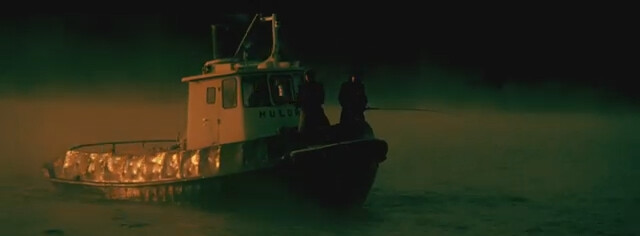
This isn’t the only extraordinary shot in the movie. In another sequence, the pastor and the Nazi go fishing together on a boat but fail to get a bite (“Perhaps the fish don’t like our uniforms,” the Nazi jokes); and as the camera slowly circles the boat the color shifts magically from light blue to a dark, hellish red and then back to blue again, briefly transforming the earth into something utterly otherworldly.
No, it’s not the fastest-moving picture of all time, and if you’re looking for action of the sort on offer in the Fast & Furious series, or a witty talkfest à la All About Eve, this probably isn’t for you. But it’s a terribly beautiful piece of work that, like Tregenza’s earlier films, ponders the slight, fraught, but precious ties between people as well as the mysteries of time and place, good and evil, man and God. In short, it’s a thoroughly Scandinavian film — by a writer-director from Kansas.
I wasn’t sure whether to relate what happens after the one-hour and ten-minute point when the Nazi-era action winds up and we fade to black. Is it over? No. After a few seconds, the film continues. But now we’re in the present day. The camera is aimed at the pastor’s cassock; it’s as if it’s been left on by mistake. A man, presumably Tregenza, steps into the shot and says (in American English) “We’re rolling.” He holds up a clapperboard and reads what it says: “Roll 9C, take 1.”
The camera begins to pan (with the familiar slowness) around the space they’re in, the large interior of a building that’s been converted to a sound stage, and we hear the low voices of the film’s cast and crew. We see a man holding a boom, a man typing away at a laptop, Andreas Lust unceremoniously yanking off his clerical collar and making a call on his cell phone. The camera sweeps past the dining room table seen in the opening sequence. We see several of the actors sitting on chairs, hanging around, waiting, all of them out of character now. They’re not acting — but they are acting, aren’t they? Because this is still the movie now — isn’t it?
Lust steps outside, and the camera accompanies him. Tregenza follows him, too, and talks to him in English about a scene. The camera pulls away from them and, in a bravura crane (or drone?) shot, swings around to show us where they are. As it happens, I know precisely where they are: they’re in the Telemark town of Notodden; the building in which they’ve been filming is on the Tinn River, a one-minute walk, as it happens, from where I live. Ellen Dorrit Petersen comes outside and Tregenza directs her in a shot that we saw at the beginning of the movie: arriving in the town with her suitcase, Anna seems not to be walking but to be gliding (it’s reminiscent of a memorable shot in The Umbrellas of Cherbourg of Guy walking his bicycle). We can now see the trick: she’s standing on a small platform on rails being pulled by a crew member.
This long final sequence recalls the end of Woody Allen’s Stardust Memories, in which the actors, now out of character, discuss with one another their experience filming the movie. The difference is that while that sequence lasted only a few seconds, this one times out at just over twenty minutes. Like the sequence involving the flatbed truck and the coffin, it, too, is all done in a single shot. Obviously, we’re supposed to consider it to be part of the film. But why?
I’ll put it this way. In the first part of the movie, we’re very aware of its artifice, and aware of its unseen creator, Tregenza; this final sequence, however, is pure realism, and Tregenza himself participates in the action, much of it seen from above, through what truly do seem to be God’s eyes. Yet in the wake of the Nazi-era sequences, the quotidian events of this closing section, lifted out of time by the same slow, deliberate camera, feel equally imbued with meaning and mystery, no more or less sub specie aeternitatis — under the aspect of eternity, under the eye of God — than the fictional story set during World War II. Suffice it to say that there’s something strangely moving and mystical about it all — something poetic and profound about the sacredness of nature and the numinous, of people and the places through which they move, of human interaction in time.
As I’ve said, although Tregenza is American, this is a decidedly Scandinavian film. There’s a reason why Scandinavian films are the way they are. In an earlier chapter of my life, I spent long periods in the eternal sunshine of southern California, and I loved it, although I found that it was a place where I simply couldn’t read, say, a Russian novel; Tolstoy or Dostoevsky seemed to be writing about an entirely different world from the mindlessly happy, godless utopia in which I found myself. Living through a winter in Telemark is a different proposition; the days are short, the going tough, the daylight hours crowded with mundane tasks, and the nights heavy with thoughts of mortality and the transcendental. Plainly that’s why Rob Tregenza chose to film The Fishing Place down the road from my home.
The Fishing Place opens in New York City on Feb. 6 and in Los Angeles on March 7, and I recommend it very highly.
READ MORE from Bruce Bawer:
Grilling Hegseth: Democrats Expose Their Spiteful Hypocrisy