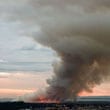


The Big Burn: Teddy Roosevelt and the Fire That Saved America
By Timothy Egan
(Houghton Mifflin Harcourt, 324 pages, $27)
During my 1970s college days I spent a summer working for the United States Forest Service (USFS) on the Plumas National Forest in Northern California. Our crew performed trail maintenance and campground cleanup, and helped “mop up” one small local forest fire. In most of these jobs we used a tool with a long handle called a “Pulaski,” which can best be described as half axe and half mattocks, the latter a broad-blade pick. Along with our gallon steel orange canteens and hard hats, everybody had one. A pulaski was useful for all manner of chopping-digging-picking. Back then, I never knew how it got its name.
On August 20-21, 1910, the Northwest was visited by the largest forest fire so far seen in American history. “The Big Burn,” as it’s been called every since, incinerated three million acres (the size of Connecticut) of forest in two days, when it roared across adjacent parts of Washington, Idaho, Montana, and the Canadian province of British Columbia. It killed 85 people and scorched several towns. Smoke wafted as far east as Chicago. The conflagration and its political ramifications are the title and subject of a book by Timothy Egan, the Seattle-based correspondent of the New York Times, and winner of the National Book Award in 2006 for his history of the 1930s Dustbowl, The Worst Hard Time.
The catastrophe was paradoxically a godsend for the reputation of Gifford Pinchot, the first Chief of the USFS, and a conservation ally of former president Theodore Roosevelt, who had appointed Pinchot to the job in 1905. Pinchot, a trained forester, was — like Roosevelt — an Ivy League aristocrat with a love of the outdoors. Egan writes: “Both were adrenaline addicts and thrill seekers, the longer the odds, the better.” At their first meeting in 1899, when Roosevelt was Governor of New York, the pair wrestled and boxed on a mat at the governor’s mansion.
But the USFS was in a bad way in 1910. Its patron Roosevelt was out of office, and the new president — the corporate-friendly William Howard Taft — cared nothing for continuing TR’s legacy of preserving a portion of the Western public lands for national parks, national forests, and wildlife refuges. Taft had fired Pinchot over policy battles with the president’s new Secretary of the Interior, Richard Ballinger. Both Taft and the U.S. Congress were in the midst of starving the USFS budget when the great fire occurred, the details of its horrors on the front page of every large city daily newspaper in America. Roosevelt and Pinchot used the media attention as a public relations tool to lobby the Congress for more budgetary support for the public lands agencies.
The fire that Egan describes so vividly was a perfectly hellish convergence. Small fires were already burning in the area, the result of previous dry lightning and sparks from a railroad locomotive. Then a hurricane wind arose from a cold front. This caused the small fires to “blow up,” converge, and race eastward through a half dozen summer-dry national forests. Egan describes the scene as one “…of trees swelling, sweating hot sap, and then exploding; of horses dying in seconds; of small creeks boiling, full of dead trout, their white bellies up; of bear cubs clinging to flaming trees, wailing like sobbing children.”
Near Wallace, Idaho, a USFS ranger named Edward Pulaski was supervising a fire crew on one small fire when the blowup appeared on the horizon. He had 45 men to fight the fire in his area, but it was futile, and the entire crew ended up trying to survive in a cave as the inferno roared by outside. The fire killed five men, but forty were saved thanks to Pulaski’s resourceful leadership. He himself suffered permanent eye injuries. One third of nearby Wallace burned. Ed Pulaski is credited with inventing his namesake forest firefighting tool still used today. But he never patented it. And he was never compensated by the government for his eye problems. After a long career in the woods he died a bitter man in 1931.
Following the Big Burn, Roosevelt and Pinchot won their public relations battle for more legislative support for the fledgling USFS. Pinchot went on to a political career, eventually becoming governor of Pennsylvania. But Egan’s larger story chronicles the effect that the fire had on subsequent USFS firefighting policy. From then on, the agency’s policy through most of the 20th century was one of aggressive tactics immediately employed to extinguish every fire, no matter how small, and this legacy is ironic. Since fire is an essential ingredient for future forest health, a century of fire suppression has left the Western public lands with tree-crowded, brush-choked forests infested with tree-killing bark beetles. These trees burn, giving us larger “crown” fires, such as The Big Burn, but this is not all bad, as the USFS currently follows a watch-and-wait policy on some fires that need to burn to remove dead trees. Though thanks to the litigious efforts of environmentalists, previously beneficial commercial logging to thin overgrown forests rarely exists on the public lands nowadays, and this is bad. Southern California’s massive “Station Fire” of this past summer is typical of modern fires in scale. When I worked for the Forest Service thirty years ago, about a million acres burned per annum was the average. Now eight to ten million acres per year isn’t unusual.
Though it is a fascinating read for someone interested in the public lands policy history of the last century, Timothy Egan’s The Big Burn is also an exciting story about a big fire that haunted the American imagination, certainly the imaginations of people who survived it, such as Ed Pulaski. The fire is the star of the book.
And besides, that weighty tool I hauled around the woods for a summer wasn’t called a “Roosevelt” or a “Pinchot.”