

Last Friday, a Fox New panel kicked around the matter of President Obama’s remarks at the G-20 meeting where he had characterized the U.S. attitude toward Europe as “arrogant,” dismissive,” and “derisive.” The United States, its President had said, was guilty of a “failure to appreciate Europe’s leading role,” in world affairs.
This was too much for Charles Krauthammer. In what he described as “a turn of phrase I’m sure I will regret,” Krauthammer said impatiently that Europe had been “sucking on the [American] teat for 60 years.”
The phrase, actually, was entirely apt. But Krauthammer was short by almost 32 years.
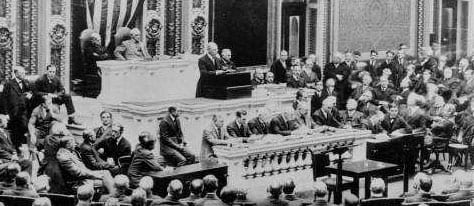
On Good Friday, April 6, 1917, Congress gave President Woodrow Wilson the declaration of war on Germany he had requested four days earlier. It was, in the words of military historian J.F.C. Fuller, “the most fateful day in European history since Varus lost his legions.”
For nearly three years, the Europeans had been busily slaughtering one another in battles like the Somme where the British lost nearly 20,000 killed in one day and Verdun where approximately 400,000 Frenchmen and 300,000 Germans were casualties in 11 months of inconclusive fighting. Europe was exhausted, bled white, and broke. But unable, or unwilling, to find a way out of history’s most catastrophic war. A war whose origins John Keegan has charitably called “mysterious.” A better word for the conflict would be “pointless.”
Still, the United States joined in; at a cost of more than 250,000 killed and wounded. Europeans tended to downplay the military contribution of the United States while a number of Americans believed that without their country’s help, the Allies wouldn’t have won the war. Winston Churchill agreed, though that did not mean he considered this a good and desirable outcome.
“America should have minded her own business and stayed out of the World War,” he told an American newspaper editor. “If you hadn’t entered the war the Allies would have made peace with Germany in the Spring of 1917. Had we made peace then there would have been no collapse in Russia followed by Communism, no breakdown in Italy followed by Fascism, and Germany would not have signed the Versailles Treaty, which…enthroned Nazism in Germany.”
We got the Treaty wrong, too. At least according to John Maynard Keynes who wrote to a friend that America “had a chance of taking a large, or at least humane view of the world, but unhesitatingly refused it.”
So, wrong in war; wrong in peace. Meanwhile, the United States helped get Europe back on its feet and kept thousands of civilians from starving. Herbert Hoover had a large hand in this effort.
Then, the United States went home and Europe went back to its old habits. According to the standard texts, American isolationism deserves a share of the blame for the rise of Hitler and, then, for World War II. Still, it is true that Hitler never made much of a secret of his intentions and that France had more tanks than he did, right up until the time he invaded and crushed her in about six weeks time.
The United States eventually got into that war, too. And this time, Winston Churchill was not so churlish about it. “To have the United States at our side was to me the greatest joy,” he wrote, describing his reaction to news of the attack on Pearl Harbor. “Now at this very moment I knew the United States was in the war, up to the neck and in to the death. So we had won after all! Hitler’s fate was sealed. Mussolini’s fate was sealed. As for the Japanese, they would be ground to powder.”
The United States sent millions of men and all manner of materiel across the Atlantic and deferred with vast politeness, as we still do, to the vanity of the British and the French. (We didn’t have to defer to the Germans; at that time, our relations with them were exceedingly straightforward.)
De Gaulle threw tantrums to get his way and Eisenhower was treated as some kind of amiable dunce by the Brits who believed they knew so very much more about war than the Yanks who, after all, had never lost 20,000 men in a single day without gaining any ground to show for it. They pushed for their man, Montgomery, whose great war-winning offensive failed in Holland in part because he was slow. At one point, his columns stopped for tea.
Meanwhile, the uncouth American fire-eater Patton, who would have advanced and won, was held back and deprived of supplies.
So that war ended and this time we stuck around. We put some Germans on trial and hanged them. Also helped create NATO. Rebuilt Europe through the Marshall Plan. Sustained Berlin with an airlift that no other nation in the world had the capacity — not to mention the guts — to bring off.
Europe was not overrun by Russian tanks. So France, under De Gaulle, pulled out of NATO as a gesture of gratitude.
The United States, innocent to the last, hung in. Until, finally, the Berlin Wall came down and we were, truly, not needed any longer. NATO was irrelevant — a mere social club that existed as an excuse to maintain a headquarters and conduct lavish conferences. This point was most emphatically driven home when a genocidal conflict erupted on Europe’s flank, in the very region where the events that had precipitated the world’s stupidest war had occurred. NATO — Europe — couldn’t manage a response. The United States, eventually, did.
“Some damned fool thing in the Balkans,” Bismarck had said when asked what would bring war to Europe. He was right. August, 1914 turned Europeans into cynics and fatalists and maybe with reason. They didn’t have an especially good century and they became bitter, cautious, and touchy. If a nation’s birthrate is a measure of civic optimism, then Europe is populated by pessimists.
Americans don’t see the world that way and don’t really need to apologize for being arrogant, derisive, and dismissive. We’ve groveled enough before the airy sophisticates. Let them keep the headquarters in Brussels for meetings. They can assemble all their combined military might on the parade ground (since the troops certainly won’t be in Afghanistan or anywhere that actual fighting is being done) for a full-dress review after which the ministers and their aides can adjourn for a good luncheon. That’s the sort of thing they are good at.
We, meanwhile, can look north, south, and west where the next opportunities and threats will come from.
And write the last 92 years off as an honest, well-intentioned mistake.