
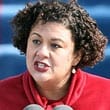


AFTER BARACK OBAMA was sworn in, Elizabeth Alexander read her “Praise Song for the Day.” I hesitate to call it a poem because it had so little connection to poetry as that art has been understood for centuries, indeed millennia. It was so dismal that the New York Times, in its 30-page special section the next day (“Full coverage of the inauguration of the 44th president”), failed to mention Alexander or print her poem. It had all the fizz of a week-old soda. No mention of it in the Washington Post either. What a decline there has been since Robert Frost’s performance at Kennedy’s inauguration in 1961.
Alexander’s turn at the podium reminded me of those dull recitations that Garrison Keillor sometimes allows on his radio program. His designated poets speak their lines in a deliberately unemphatic voice, as devoid of energy and enthusiasm as the lines themselves are of poetry. But the audience always delivers its dutiful round of applause. We have been brainwashed into thinking that it is our civic responsibility to admire anyone who comes before us as a poet.
Maybe the time has come for us to form our own judgments, and blow a raspberry or two when absolutely necessary?
I’m surprised that Keillor clutters up his program in this way. He has good taste in so many respects. He can hold your interest with any story he tells, and mockery of intellectual pretension is his stock in trade. Perhaps it has something to do with his running gag about English majors. Many modern poets are employed by EngLit departments so maybe they’re all listening in to “A Prairie Home Companion” on Saturday night, waiting to see who gets Keillor’s nod.
How did Ms. Alexander become Barack’s pet poet? Political connections helped; political correctness was a given. Let’s call her QuotaPoet and drop all mention of laureates from now on. Congress created a “poet laureate” position in 1986, but the whole notion of laurels is at cross-purposes with modern poetry.
Not that Alexander is the laureate, yet. She is the daughter of Clifford Alexander, Secretary of the Army under President Carter. Her mother teaches African American women’s history at George Washington University. (Do they have men teaching men’s history?) Alexander herself met Barack Obama at the University of Chicago. No surprise, she is a professor of African American Studies at Yale.
Ms. Alexander and her ilk dwell in the sheltered world of Poetry Corner, a subset of the Academy. It is awash in more fellowships, honors, awards, grants, subsidies, and prizes than you can imagine. And don’t ask about the workshops. Joseph Epstein, in his great essay “Who Killed Poetry?” (Commentary, 1988), quotes Kingsley Amis as saying that everything that has gone wrong with the world since World War II can be summed up in the word “workshop.” In London, years ago, I heard Bernard Levin say much the same thing.
Alexander’s poem was criticized for not rising to the occasion, and of course it did not. Adam Kirsch in the New Republic called it “a perfect kind of bureaucratic verse.” But he meant that as a back-handed compliment. The “praetorian pomp” of Obama’s inauguration seemed “more redolent of Caesar than George Washington.” So she brought everything down to earth.
Nonetheless, Kirsch added, “it was just the kind of event that might inspire genuine poetry.” But didn’t, obviously. The Times reported before the inauguration that Alexander was wondering how to start a piece that will “mark an occasion as historic, has a worldwide audience and will have an immediate impact.”
Well, here is how she started it—her opening lines:
Each day we go about our business, walking past each other,
catching each other’s eyes or not, about to speak or speaking.
That could hardly be more wooden. A critic with the L.A Times further commented: “Each day we go about our business” was “a strange sentiment for an occasion that on so many levels was not about business as usual.”
Spot on. But the more basic point is that today’s academic poetry is not about celebrating occasions or celebrating anything. It has a different agenda. It wages an undeclared war against the whole idea of poetry as it has traditionally been understood. It’s a lightweight steamroller that would like to flatten the monuments of the past. We can ignore it, but it’s not up to any good.
ALEXANDER HAS SAID that “music is the point” of poetry, and “the way I dive in is through music and language itself.” OK, but the problem is that her lines showed her ear to be in thrall to the anti-music of the modern. Consider this line. She is eulogizing the dead, who, among other things,
built brick by brick the glittering edifices they would then keep clean and work inside of.
work inside of. Imagine ending a line that way and daring to call it poetry. Imagine being so culturally secure and cushioned by privilege that you can present that as inaugural poetry without fear of embarrassment. The artistic career of Elizabeth Alexander suggests that the self-esteem campaign has gone on for long enough.
In the past, some of those inside the poetry citadel have responded to criticism by saying: “Oh, you just don’t like modern poetry.” Joseph Epstein had a good riposte, and he also identified the underlying problem, or one of them.
Lots of modern poets have been well appreciated and honored, even those considered “difficult.” He mentioned T. S. Eliot, Wallace Stevens, William Carlos Williams. Auden, Yeats, Pound, Frost and others. The point is that they were amateurs—in the best sense of the word. They wrote poetry for love whether or not they were paid. They had day jobs: banker (Eliot), doctor (Williams), insurance executive (Wallace Stevens), librarian (Philip Larkin). As they say: subsidize something and you get more of it. And boy, we have whole anthills of poets today. As Epstein summarized the field, poetry “flourishes in a vacuum.” More than 250 universities had creative writing programs when he wrote, all with a poetry component. Dana Gioia, in an excellent Atlantic Monthly article in 1991, put the figure at 200. With 10 students in each section, he wrote, unreassuringly, “these programs alone will produce about 20,000 accredited professional poets over the next decade.”
More recently Gioia became chairman of the National Endowment for the Arts. I believe he has done what he can to rein in grants for individual poets.
The Directory of American Poets and Fiction Writers listed over 6,300 poets and other writers. Donald Hall, who was Poet Laureate of New Hampshire and more recently of the U.S.—his aggrieved response to Epstein was published in Harper’s—said that 1,000 books of poetry are published every year. About 7,000 volumes of poetry were published from 1990 to 2001.
By comparison, in 1941 there were said to have been 151 American poets.
The market for the poetry tsunami is not strong, consisting mostly of other poets. It’s wise for a publisher to anthologize 100 poets in one volume; that way it will at least sell 100 copies. Dana Gioia memorably noted his own reaction to the “several dozen journals” that print nothing but verse.
The heart sinks to see so many poems crammed so tightly together, like downcast immigrants in steerage. One can easily miss a radiant poem amid the many lackluster ones. It takes tremendous effort to read these small magazines with openness and attention. Few people bother, generally not even the magazines’ contributors. The indifference to poetry in the mass media has created a monster of the opposite kind—journals that love poetry not wisely but too well.
CREATIVITY UNACCOUNTABLY waxes and wanes at different times and places. Our own time has every appearance of being bad for poetry. I personally would advise a creatively inclined youth to stay away the fine arts altogether. Standards have collapsed so completely—perhaps I should say deliberately undermined by what Philip Larkin called “the aberration of modernism that blighted all the arts”—that only political criteria now seem valid when it comes to deciding what’s good or not. Malcolm Muggeridge once said that real creativity in our time shifted from those fields where you are encouraged to do your own thing and innovate without regard to tradition or “rules”—poetry, painting, academic music—into fields such as technology and engineering where the created machine imposes its own discipline. Compare, for example, the abstract paintings of a Mark Rothko or a Barnett Newman with the Golden Gate Bridge or a Boeing 747. Where do you think the aesthetic impulse of our time found its true outlet?
“The crowds in London once stood on their toes to see Tennyson pass,” Joseph Epstein wrote. Today, however,
a figure like Tennyson probably would not write poetry and might not even read it. Poetry has been shifted—has shifted itself?—off center stage. Literarily, poetry no longer seems in any way where the action is.
But might there not be some good and serious poets out there, amidst the careerists? Poetry’s appeal to its creators and to its audience is potentially so strong that there will always be those who will try to achieve something great in verse, difficult though it is. Some are surely trying now, and one or two may even be succeeding. But how would we know?
There is little coverage of poetry in the general press. Leading critics rarely review it. “In fact, virtually no one reviews it except other poets,” Dana Gioia wrote. Most editors run poetry “the way a prosperous Montana rancher might keep a few buffalo around—not to eat the endangered creatures but to display them for tradition’s sake.”
The subsidized poets themselves have complained about the critical void, because they well know that as long as all their efforts are received with an equal and democratic deference, the whole notion of distinction (in both senses—distinguished and differentiated) will be lost. When modern criticism is occasionally found, Gioia said, it is uniformly obsequious, whereas until a few decades ago it was often sharp and even embarrassing to the poet at the receiving end.
Today, in consequence, everything is undistinguished. How can anyone plow through those thousand volumes a year? The good will be buried beneath the ever-rising snowdrifts from the grant- and tenure-seekers. (Academic philosophy is subject to the same adverse forces, I believe. If there is good philosophy coming out of the academy, as is quite possible, we will be hard pressed to discover it.)
THERE IS ONE SOLUTION: Cut off all the subsidies. Let poetry be restored to the marketplace. Maybe 150 poets would survive, as in 1941. No such cuts will happen, of course, if only because there are so many generous-hearted and wealthy people around who cannot imagine that more money for something good in itself (poetry) will not produce more of the good; and may actually stifle it.
Meanwhile the best of luck to Elizabeth Alexander. Her website assures us that she is “one of the most vital poets of her generation,” and, what’s more, “a pivotal figure in American poetry.” So she will not be needing my blessing. Her pivotal performance showed that she moves with great self-assurance in the mainstream of today’s academic poetry. But I wonder how many of her rivals envy her credentials, and the accidents of birth, which conferred upon her this rare distinction.




















